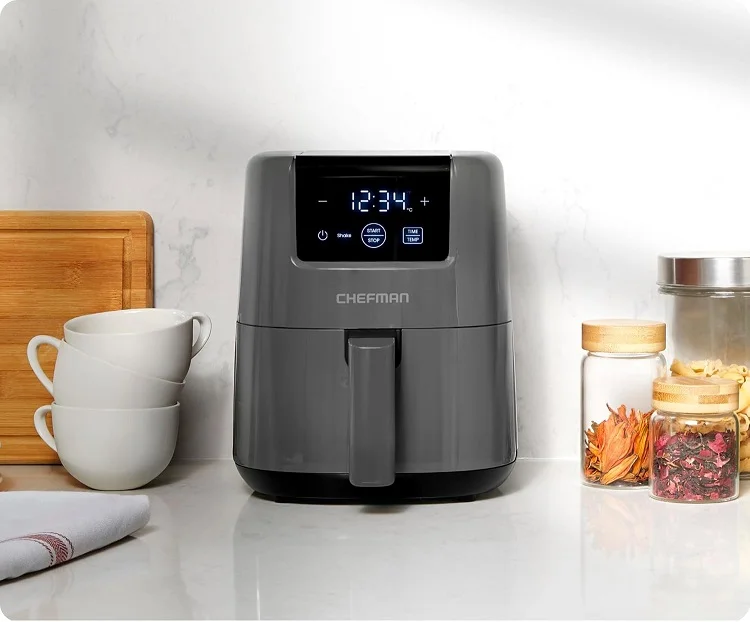
Air fryers can be a convenient way to cook smaller meals without heating a full-size oven. If keeping electricity use down is a priority, compact models with lower power ratings can be worth considering, particularly for one or two portions.
The key is not simply choosing the lowest wattage. Cooking time, basket size and the amount of food you prepare also affect how much electricity an air fryer actually uses.
Below, we’ve selected five energy-saving air fryers available in the UK, comparing their power, capacity, controls and useful features to help you find the right option for your kitchen.
1. COSORI 4.7L Air Fryer

The COSORI 4.7L air fryer is a relatively compact model designed to serve up to four people while using a 1500W power rating. Its rapid heat circulation is designed to cook food faster than a conventional oven, with COSORI claiming up to 55% lower energy use. The 230°C maximum temperature also gives it enough range for everyday air frying as well as higher-temperature cooking.
Key points:
- 4.7L capacity for meals serving up to 4 people
- 9 cooking functions including chicken, fries, steak, seafood and vegetables
- Digital tempered-glass display for easy control
- 30+ recipes included in the cookbook
- Non-stick removable basket for easier cleaning
- Dishwasher-safe basket for convenient maintenance
- 55 dB operating noise for quieter cooking
- Up to 85% less fat than traditional deep frying
- 230°C maximum temperature for high-heat cooking
2. Philips Air Fryer 3000 Series Dual Basket 9L

The Philips 3000 Series Dual Basket is a 9L air fryer designed around cooking two different foods at the same time. It combines a larger 6L basket with a 3L basket and uses synchronised cooking times so both dishes can finish together. Its RapidAir Plus technology circulates hot air through the baskets, while the dual-basket setup can reduce the need to use a conventional oven for smaller multi-dish meals.
Key points:
- 9L total capacity with 6L and 3L baskets
- Dual-basket design for cooking two foods simultaneously
- Synchronised cooking times so both baskets finish together
- RapidAir Plus technology for circulating hot air around the food
- 13 cooking functions for different types of meals
- Digital touchscreen for adjusting cooking settings
- Dishwasher-safe components for easier cleaning
3. Ninja Double Stack XL Air Fryer 9.5L

The Ninja Double Stack XL is a large-capacity air fryer with two independent 4.75L drawers and two cooking racks, giving you four cooking levels while taking up less counter width than some conventional dual-drawer designs. Ninja states that it can use up to 55% less energy than an oven when using the air fry function for its tested sausage cooking comparison.
Key points:
- 9.5L total capacity for up to 8 people
- Two independent cooking zones for preparing different foods simultaneously
- Four cooking levels using two drawers and two racks
- Six cooking functions including Air Fry, Max Crisp, Roast, Bake, Reheat and Dehydrate
- Up to 55% less energy than an oven based on Ninja’s stated testing
- Up to 55% faster cooking than a fan oven in stated tests
- SYNC and MATCH functions for coordinating the two drawers
- Dishwasher-safe parts for easier cleaning
4. Tefal Easy Fry Mega 7.5L

The Tefal Easy Fry Mega combines a 7.5L cooking capacity with an energy-saving design aimed at larger households. Tefal claims it can use up to 65% less energy and cook up to 37% faster than a conventional oven, based on its 2024 testing with frozen fries. It offers both preset and manual cooking options, making it suitable for a wide range of meals.
Key points:
- 7.5L capacity serving up to 8 people
- 8 preset programmes for different types of food
- Manual cooking mode for customised settings
- 80–200°C temperature range
- Up to 60-minute timer
- Rotary control knob for adjusting time and temperature
- Up to 65% less energy consumption based on Tefal’s stated testing
- Up to 37% faster cooking than a conventional oven in stated tests
5. Russell Hobbs 4L Rapid Digital Air Fryer

The Russell Hobbs 4L Rapid Digital Air Fryer is a medium-sized model with a 220°C maximum temperature and a digital control panel. It is specifically marketed with energy efficiency in mind, with the manufacturer stating that it can save up to 46% energy compared with a conventional oven. Its 4L capacity provides a useful middle ground between compact personal air fryers and larger family models.
Key points:
- 4L cooking capacity
- 10 preset programmes covering foods such as fries, chicken, vegetables and fish
- 220°C maximum temperature
- Digital touch display for simple operation
- Shake reminder alerts you when food should be turned during cooking
- Non-stick fry basket and crisping plate
- Dishwasher-safe components for easier cleaning
- Up to 46% energy saving compared with a conventional oven
What to Look for in an Energy-Saving Air Fryer
Choosing an energy-efficient air fryer isn’t simply about finding the lowest wattage. The size of the basket, cooking time, temperature and amount of food you prepare all affect electricity consumption.
Wattage
Wattage tells you how much electrical power the air fryer can draw while operating. The models in this guide range from 1000W to 1500W, which is relatively modest compared with many larger air fryers.
However, a higher-wattage model isn’t necessarily more expensive to run. If it cooks food faster, it may use a similar amount of electricity over the complete cooking cycle.
Capacity
Choose a capacity that matches the amount of food you normally prepare. A 1.5L or 2L air fryer can work well for one person or small portions, while larger households will generally need a bigger basket.
Using a compact air fryer for small meals can avoid heating a larger cooking chamber than necessary.
Cooking Speed
Cooking time is an important part of energy consumption. An air fryer that heats quickly and cooks food efficiently may use less electricity during a complete meal than a lower-powered model that needs to run for considerably longer.
Temperature Control
Adjustable temperature control lets you select the appropriate heat for different foods instead of always using the highest setting.
A wider temperature range also gives you more control over cooking, particularly when preparing foods with different requirements.
Timer and Automatic Shut-Off
A timer helps control cooking time and prevents the air fryer from running longer than necessary. Automatic shut-off is another useful feature because the appliance can stop when the cooking cycle finishes.
Digital controls can make precise settings easier, while manual dials offer a simple way to adjust temperature and time.
Basket and Cleaning
A removable non-stick basket makes cleaning easier, particularly if you use the air fryer regularly. Dishwasher-safe components can make the cleaning process even simpler.
Benefits of Using an Energy-Saving Air Fryer
Lower Electricity Use
A compact air fryer can use less electricity than a full-size oven when preparing small meals. The potential saving depends on the appliance, cooking time and amount of food being prepared.
Faster Cooking
Many air fryers heat and circulate hot air quickly, which can reduce cooking times for certain foods compared with a conventional oven.
Compact Design
Small air fryers take up less counter space and are easier to store. Their smaller cooking chambers also mean you don’t have to heat a large space when preparing a small portion.
Less Oil
Air frying uses circulating hot air instead of requiring food to be submerged in oil. Depending on the recipe, you can often cook with little or no added oil.
Tips for Saving Electricity When Using an Air Fryer
Cook the Right Amount
Try to prepare enough food to make good use of the basket without overcrowding it. Overfilling can restrict airflow and may result in longer cooking times.
Avoid Unnecessary Preheating
Not every recipe requires preheating. Check the instructions for your food and appliance before automatically running a separate preheat cycle.
If preheating is recommended, use only the time required.
Don’t Open the Basket Too Often
Opening the basket releases hot air and can increase cooking time. Check the food when necessary, but avoid repeatedly opening the drawer during cooking.
Keep the Air Fryer Clean
Remove grease and food residue regularly. A clean basket and unobstructed airflow can help the appliance maintain consistent cooking performance.
Use the Correct Temperature
A higher temperature doesn’t always mean faster cooking. Follow the recommended temperature for the food and adjust the cooking time when necessary.
Match the Air Fryer to Your Meals
For one or two portions, a compact 1.5L or 2L model can be more practical than a large-capacity air fryer.
The aim is to choose a size that suits the amount of food you normally cook rather than buying a much larger appliance than necessary.
Are Low-Watt Air Fryers Cheaper to Run Than an Oven?
They can be, particularly when you’re preparing small meals.
A compact air fryer heats a much smaller cooking area than a full-size oven, and many foods take less time to cook. This can make an air fryer an economical option for smaller portions.
The exact saving will depend on the oven, air fryer, cooking temperature, cooking time and amount of food being prepared.
For larger meals, however, a conventional oven may be more practical because it can accommodate substantially more food in one batch.
What Size Air Fryer Uses the Least Electricity?
Smaller air fryers generally have lower power ratings, but the lowest wattage isn’t automatically the most economical option.
A 900W air fryer may use less power while operating than a 1500W model, but if it requires several batches to cook the same amount of food, the total electricity used can increase.
For this reason, choose an air fryer that is large enough for your usual portions without being unnecessarily large.
How Can I Calculate the Cost of Running an Air Fryer?
You can estimate the maximum electricity used by multiplying the air fryer’s wattage by the number of hours it operates, then dividing the result by 1000 to get kWh.
For example:
900W × 0.5 hours = 450Wh = 0.45kWh
To calculate the approximate cost, multiply the kWh figure by your electricity tariff.
Keep in mind that this is a simple estimate based on the rated power. An air fryer’s heating element may not operate at full power for the entire cooking cycle, so actual consumption can differ.