✓ Reviewed by the Ultimate House Team
Oil-Filled Radiators for Heating Larger Living Spaces
Large rooms need a radiator that can deliver steady heat without constantly cycling on and off. Oil-filled models are well suited to this because they retain heat and continue warming the room after the heating element switches off. We’ve compared models with different heat outputs, controls and sizes to help you choose one that suits a larger space.
» OUR TOP PICKS

01 · Best Overall
De’Longhi Dragon 4 2kW Oil Filled Radiator
Excellent
KEY DETAILS
Power: 2kW | Heat settings: 3 | Room size: Up to 60m³ | Heating method: Convection | Timer: 24-hour mechanical | Thermostat: Yes | Safety: Overheat protection and anti-frost function | Colour: White
The De’Longhi Dragon 4 is a 2kW oil-filled radiator designed for rooms up to 60m³. Its enlarged fin design creates a chimney effect that helps circulate warm air, while three heat settings, a thermostat and 24-hour timer provide practical control.
WHAT WE LIKE

02 · Best for Smart Temperature Control
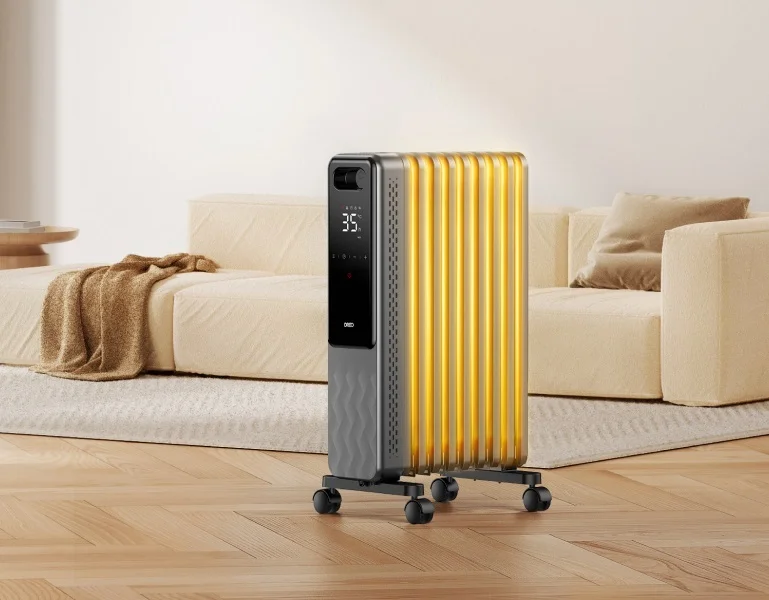
DREO 2000W Smart Oil Filled Radiator
Excellent
KEY DETAILS
2,000W | Heat settings: 800W, 1,200W and 2,000W | Temperature range: 5–35°C | Fins: 8 M-shaped fins | Thermostat: Digital | Timer: 24-hour | Control: App, Alexa and Google Assistant | Colour: Grey
The DREO 2000W is an oil-filled radiator with digital temperature control and smart connectivity. It offers three heating levels and an ECO mode, with an ambient temperature display and app control for adjusting settings remotely around the home.
WHAT WE LIKE

03 · Best Budget
Devola 2.5KW Oil Filled Radiator
very good
KEY DETAILS
Power: 1,000W, 1,500W and 2,500W | Fins: 11 M-shaped | Thermostat: Digital | Display: LCD | Timer: 24-hour | Safety: Child lock, overheat and 40° tip-over protection | Colour: Anthracite Black
The Devola 2.5KW is an 11-fin oil-filled radiator with three heat settings and digital temperature control. Its LCD display, ECO mode and 24-hour timer make it suited to larger rooms where precise adjustment and scheduled heating are useful.
WHAT WE LIKE

04
NETTA 2500W Oil Filled Radiator
very good
KEY DETAILS
Power: 2,500W | Fins: 11 | Heat settings: 3 | Thermostat: Adjustable | Timer: 24-hour | Safety: Overheat and tip-over protection | Cable: 1.5m | Weight: 9.85kg
The NETTA 2500W is an 11-fin oil-filled radiator designed for medium to large rooms. Its three power settings let you select between different heat outputs, while the adjustable thermostat and 24-hour timer provide control over when and how the heater operates.
WHAT WE LIKE

05
VonHaus 2500W Oil Filled Radiator
Good
KEY DETAILS
Power: 2,500W | Fins: 11 | Heat settings: 1,000W, 1,500W and 2,500W | Timer: 24-hour | Thermostat: Adjustable | Safety: Overheat and 45° tip-over protection | Cable: 1.5m | Wheels: 360° castor wheels
The VonHaus 2500W oil-filled radiator combines 11 fins with three selectable heat outputs for different heating requirements. Its 24-hour timer, adjustable thermostat and portable wheel design make it suited to larger rooms where flexible control and movement are useful.
WHAT WE LIKE
Buying Guide & FAQ
What to Look for in an Oil-Filled Radiator for a Large Room
The main specification to check is power output. A 2,000W radiator can be suitable for many larger rooms, while a 2,500W model provides a higher maximum output when more heat is required. Room size, insulation, ceiling height and draughts all affect how much heating a space actually needs, so wattage should not be considered in isolation.
Check the room size carefully
Manufacturers sometimes give room-volume or room-area guidance. These figures are useful as a starting point, but the construction of the room also matters.
A well-insulated room with double glazing may retain heat considerably better than a draughty room with poor insulation. If the room has high ceilings, large windows or external walls on several sides, you may need more heating capacity than the basic floor area suggests.
Consider the maximum heat output
For a large room, look at the highest available wattage as well as the lower settings.
Useful options include:
- 2,000W: suitable for many larger rooms and regular top-up heating
- 2,500W: gives greater maximum heating capacity
- Multiple settings: allow you to reduce output once the room becomes comfortable
A radiator does not necessarily need to run at its highest setting continuously. Having lower power levels can make the heater more practical once the room has warmed.
Look at the number and design of fins
The fins provide the surface through which heat is transferred into the surrounding air. Larger radiators with more fins can offer a greater heat-dissipation area, although the overall design and power output remain important.
An 11-fin radiator such as the NETTA or VonHaus provides a larger radiator body than a smaller model, which can be useful when heating a more substantial room.
Thermostat control is important
An adjustable thermostat lets you select the desired temperature rather than simply leaving the heater permanently switched on at one fixed output.
This is particularly useful in a large room because temperatures can change throughout the day. Once the room reaches the selected temperature, the thermostat can regulate the heating rather than requiring constant manual adjustment.
A timer can reduce unnecessary running
A 24-hour timer is useful if you have predictable heating requirements.
For example, you could schedule the radiator around your working hours or set it to operate at particular times in the morning and evening. Mechanical timers are straightforward, while digital controls can offer more precise programming depending on the model.
Check the safety features
A portable electric radiator should have appropriate built-in safety protection.
Useful features include:
- Overheat protection
- Automatic thermal cut-off
- Tip-over protection
- Anti-frost settings where required
- A stable wheeled base
- Adequate cable storage
Always position the radiator on a stable, level surface and keep curtains, furniture, bedding and other combustible materials away from it.
Oil-filled versus oil-free
It is important not to treat oil-filled and oil-free radiators as the same type of heater. Oil-filled models contain thermal fluid inside the radiator and are designed to provide steady heat after the element has warmed the fluid. Oil-free models use a different heating construction and can have different warm-up and heat-retention c haracteristics.
Think about running costs
A 2,500W radiator uses more electricity at full power than a 2,000W model. However, the actual running cost depends on how long the heating element operates and how the thermostat controls the temperature.
The basic calculation is:
Power in kW × electricity price per kWh = cost per hour at full power
For example, a 2kW radiator operating continuously would use 2kWh of electricity per hour. In normal use, thermostat cycling means it may not draw its maximum rated power continuously
What is the advantage of having several heat settings?
Several heat settings allow you to select a lower output once the room is warm or when less heating is needed. For example, the VonHaus model offers 1,000W, 1,500W and 2,500W settings, while the DREO provides 800W, 1,200W and 2,000W options.