
Best Pillows for Side Sleepers for Better Neck Support and Comfort
When you sleep on your side, a flat pillow can leave your neck bending towards the mattress, while an overstuffed one pushes it the other way. Neither is ideal when you’re trying to get comfortable through the night. Pillow height, filling and even mattress firmness all play a part.
Our review of the best pillows for side sleepers covers the features that matter most, helping you find a comfortable balance between cushioning and support.
 01
TEMPUR’s Original ergonomic pillow has a medium-firm foam core shaped to support the gap between your neck and mattress when you lie on your side. Its two contoured edges offer different resting heights, while the responsive material moulds gently around your head. The removable cover makes regular washing more straightforward.
Pros
- Designed to suit small and medium body frames
- Contoured neck ridge offers a defined resting position
- Shape-retaining foam needs no regular plumping
- Removable cover can be washed at 60°C
- Three-year guarantee offers longer-term reassurance
 02
DISSA’s cervical pillow uses higher side sections to support your head when you sleep on your side, with a lower central cradle for back sleeping. That makes it useful for people who change position at night. Slow-rebound memory foam provides a defined resting surface, and the cover can be washed.
Pros
- 13.7cm side zones provide loft above the shoulder
- Lower 11cm centre accommodates back sleeping
- 61cm width offers room to reposition your head
- Breathable polyester outer cover allows airflow
- Cover is machine washable; foam stays protected
 03
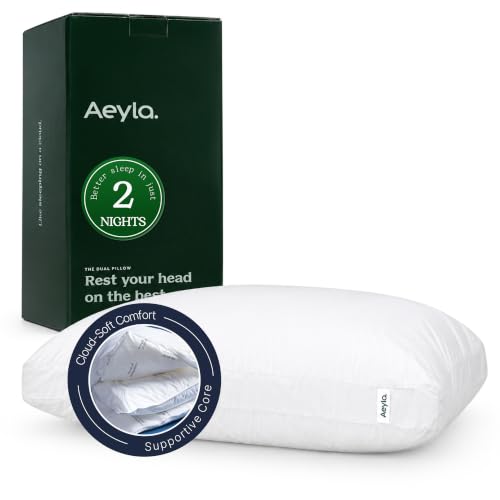
Aeyla’s Dual Pillow combines two comfort options with a familiar rectangular shape, making it appealing if you regularly switch between your side and back at night. Unlike a heavily contoured pillow, it works with standard UK bedding, and the breathable cooling cover adds comfort when the bedroom feels particularly warm.
Pros
- Standard 50 × 75cm size fits UK pillowcases
- Two comfort options in a single pillow
- CloudAlign design supports head and neck positioning
- Breathable cover helps limit heat build-up
- Also suitable for back and front sleepers
 04
The SKYNY side sleeper pillow lets you tailor the loft by removing or adding its shredded memory foam filling. That matters if your shoulder width or mattress firmness makes pillows feel too high or low. Its curved lower edge accommodates the shoulder, while the reversible cover includes a cool-feel side.
Pros
- Extra shredded foam makes customising the height easier
- Looser filling allows air to circulate between foam pieces
- Bamboo-fabric side offers a breathable surface
- CertiPUR-US and OEKO-TEX material certifications
- 100-night trial and two-year warranty
 05
Missleep’s shaped memory foam pillow has two contour heights, so you can turn it around to find a comfortable fit for your side sleeping position. The central recess gives your head a defined resting place, while the cooling cover feels smooth against the skin and can be removed for washing.
Pros
- 9cm and 12cm edges offer a choice of neck support
- Slow-rebound foam adapts to your head’s contours
- OEKO-TEX and CertiPUR-US certifications listed
- Outer cover is removable and machine washable
- Six-month warranty offers added reassurance
 06
BedStory’s two-pack suits anyone who prefers a plump pillow rather than firm, sculpted memory foam. Clusters of polyester fibre provide gentle cushioning, while the stitched side panels help spread the filling across each pillow. Both can go into the washing machine, making them practical for guest rooms and everyday beds.
Pros
- Two matching pillows refresh a bed in one purchase
- Feather-free filling suits down-free bedding preferences
- Clustered polyester fibres spring back after use
- Sideband construction helps hold the pillow’s shape
- Whole pillows are machine washable
 07
Slumberdown’s Super Support pillows offer the familiar feel of hollowfibre with extra structure from a firm foam centre. For side sleepers who prefer a traditional shape to an ergonomic contour, the pair provides a straightforward bedding refresh. Both pillows are machine washable and can be tumble dried for easy care.
Pros
- Made in the UK
- Central foam block adds structure beneath the head
- Non-allergenic synthetic materials contain no feathers
- Machine washable at 40°C for convenient cleaning
- Tumble-dryer friendly with a two-year guarantee
Buying Guide & FAQ
How to Choose the Right Pillow for Side Sleeping
Get the Pillow Height Right
Pillow height, often called loft, is particularly important for side sleepers. Your pillow needs to fill the space between your head and the mattress so your neck stays in a comfortable, neutral position.
The ideal height depends on several factors:
-
Shoulder width: Broader shoulders generally create a larger gap between the head and mattress, requiring a higher pillow.
-
Mattress firmness: A softer mattress allows your shoulder to sink further, potentially reducing the pillow height you need.
-
Sleeping position: If you curl up tightly or regularly change positions, an adjustable pillow may offer greater flexibility.
Avoid choosing a pillow based on its advertised thickness alone. What matters is how much height it maintains once your head is resting on it.
Compare Different Pillow Fillings
The filling determines how a pillow responds to pressure, retains its shape and feels against your head.
| Filling | What to expect |
|---|---|
| Memory foam | Contours around the head and neck, with a supportive, slower-moving feel |
| Latex | Responsive, springy support that generally retains its shape well |
| Down and feathers | Soft and mouldable, but may compress significantly overnight |
| Hollowfibre or microfibre | Usually affordable, lightweight and easy to maintain |
| Shredded foam | Often adjustable, allowing you to add or remove filling |
Consider Shape and Construction
Traditional rectangular pillows can work perfectly well for side sleepers, provided they offer the right support.
However, certain designs have useful advantages:
-
Contoured pillows: Feature shaped sections intended to support the natural curve of the neck.
-
Gusseted pillows: Have stitched side panels that help maintain a more consistent thickness.
-
Adjustable pillows: Allow you to change the filling height, making them useful if you’re unsure what feels right.
You don’t necessarily need an orthopaedic or specialist-shaped pillow. A conventional pillow with suitable height and firmness can be just as comfortable.
Tips for Sleeping More Comfortably on Your Side
The way you position your pillow can make a difference, even when you’ve chosen a supportive design.
-
Keep your head in line with your spine: Your neck should feel naturally supported rather than tilted upwards or downwards.
-
Rest your shoulder on the mattress: Don’t tuck it onto the pillow, as this can alter your neck position.
-
Try a pillow between your knees: This may help keep your hips more comfortably aligned and reduce twisting through your lower back.
-
Support your upper arm: Hugging a small pillow can make it easier to relax your shoulder and avoid reaching across your body.
-
Avoid twisting your neck: Keep your face pointing naturally forwards rather than turning sharply towards the mattress.
-
Give yourself time to adjust: A new pillow can feel unfamiliar at first, but persistent pain or pressure is a sign that the fit may be wrong.
Is a High or Low Pillow Better for Side Sleepers?
Side sleepers generally need more pillow height than back or stomach sleepers because of the space created by their shoulders. However, a higher pillow isn’t automatically better. The correct height keeps your head aligned with your spine after the filling compresses under its weight. If you frequently wake with a stiff neck, check whether your pillow is pushing your head upwards or allowing it to drop towards the mattress.
Can the Wrong Pillow Cause Neck or Shoulder Pain?
An unsuitable pillow can contribute to discomfort by holding your neck in an awkward position for several hours. However, shoulder and neck pain can also have other causes, including mattress pressure, sleeping habits and underlying health conditions. A different pillow may improve comfort, but persistent or worsening pain should be assessed by a healthcare professional.
How Often Should You Replace Your Pillow?
There’s no fixed replacement schedule that suits every pillow. Lifespan depends on its filling, construction, quality and how well you maintain it.
Consider replacing your pillow if it:
-
Stays flat or lumpy after fluffing.
-
No longer supports your head comfortably.
-
Develops persistent odours or visible deterioration.
-
Causes you to repeatedly fold or bunch it up for support.
Our Top 3 Picks